

27th November 2025

by Brittany Delany
What Happens in a Full Car Service? Your Complete Guide
Why a Full Car Service Matters
What happens when gettng a full car service? Getting a full vehicle service is your car’s equivalent of a health screening or flu shot. Preventative care is always best and it gives our mechanics the chance to spot early warning signs whilst they’re still easy (and cheap) to take care of, meaning you’re less likely to experience any major faults as well as improve the lifespan of your vehicle. Depending on your mileage and the vehicles age, a full service is usually recommended every 2 years, alternating with an interim service every other year too. Many motorists often schedule their service at the same time as their MOT, although these are two very different things. Learn more about what MOTs are and how they differ here. An interim service, is less comprehensive but still tests all your car’s major systems and can be a great check-up, especially if your car sees a lot of mileage throughout the year.
What’s the difference between a Full and Interim Service?
When it comes to maintaining your car, it’s helpful to understand the difference between an interim service and a full service. A full service includes everything found in an interim check- plus a range of additional, more in-depth maintenance tasks.
What’s Included in an Interim Service?
An interim service is a shorter, essential health check for your vehicle. It typically includes:
- A ramp inspection, looking over the steering, suspension, and key safety functions while the car is lifted- but without removing the wheels.
- A visual check of the brakes (where visible), assessing everything that can be seen without further disassembly.
- An engine oil and filter change.
- Checks and adjustments of lights, levels and tyre pressures.
- A test of the vehicle’s electrical equipment to ensure everything is working as it should.
This service is designed to keep your car running smoothly between full services by identifying visible issues early.
What’s Included in a Full Service?
What happens in a full car service? The full service covers all of the checks and tasks included in an interim service, but goes further to ensure every serviceable part is inspected- and replaced where needed- to keep your vehicle running reliably.
In addition to the interim service, during a full service both the air filter and pollen (cabin) filter are replaced. On diesel vehicles, the fuel filter is also changed, while on petrol vehicles, the spark plugs are replaced.
In addition, the wheels are removed to allow for a comprehensive brake inspection. And if the vehicle has rear drum brakes, these are stripped down, cleaned, and adjusted.
Because the wheels come off during a full service, technicians can carry out a far more detailed inspection of areas that are not visible during an interim service. This deeper level of maintenance helps catch wear and tear early and ensures your vehicle remains safe and performing at its best.
What a Full Service Doesn’t Cover (and What Costs Extra)
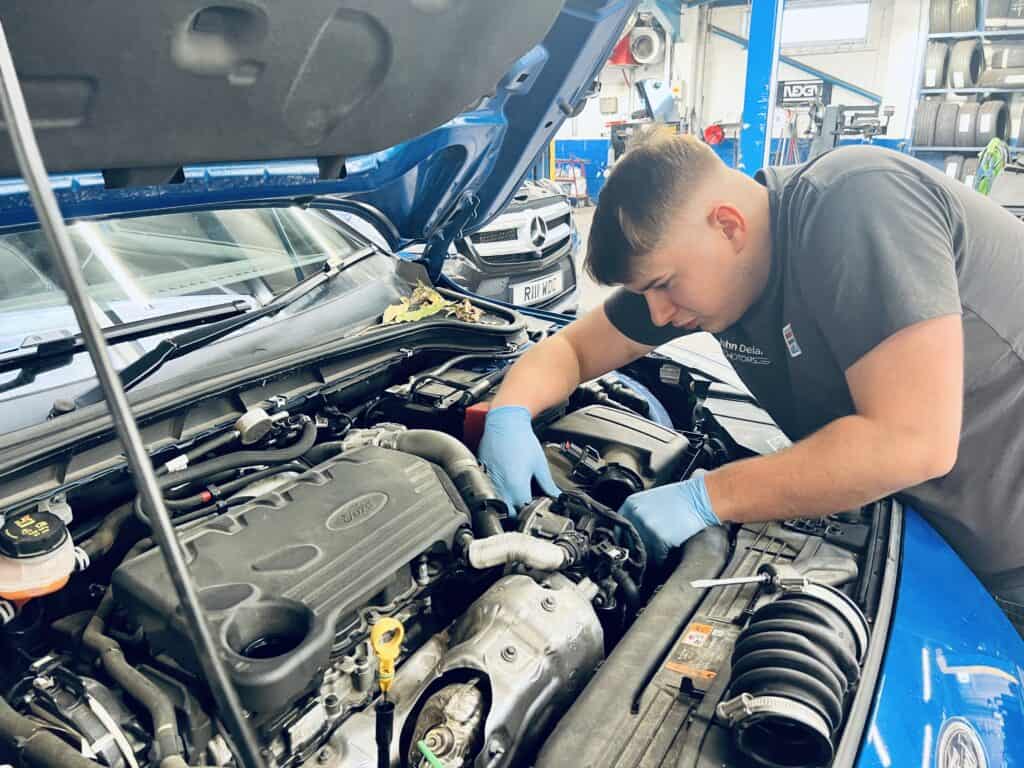
Our full vehicle service option is the most comprehensive and includes many checks which are not available with our interim service, however, there are still some items that are not included in either service.
An MOT is closer to an inspection than a service, making sure that the vehicle meets the minimum standards set by the DVSA. Parts can be worn and require replacement but still pass the MOT test as advisories. During an MOT test we would note any issues but not replace or repair them, any issues would be reported to you with the option to repair them if you require.
There are optional extras that we can include as part of your service for an additional charge, which are as follows:
- Topping up your antifreeze, where necessary, which is especially important in the winter months to reduce the likelihood of weather-related engine troubles.
- An engine management code read, which involves using a diagnostic code reader to access the data stored on your vehicle’s engine control unit and can indicate any internal issues with your engine that would require further inspection or repairs.
The Importance of a Regular Service
We recommend getting a your vehicle serviced once every year or according to manufacturers recommendations. As previously mentioned, many people will book their MOTs at the same time, but only an MOT is legally required. Cars come with a lot of maintenance, and it’s important for drivers to check their tyres, battery, engine oil levels, and a host of other things – ideally every time you get behind the wheel – but there are certain things that you just can’t check yourself. That’s why regular servicing is so vital; the list of checks we perform seems exhaustive because it needs to be, and a professional service by one of our qualified mechanics is the best way to make sure that you stay safe when you drive.
Give us a call if you want to book in or to find out what happens in a full car service now.